
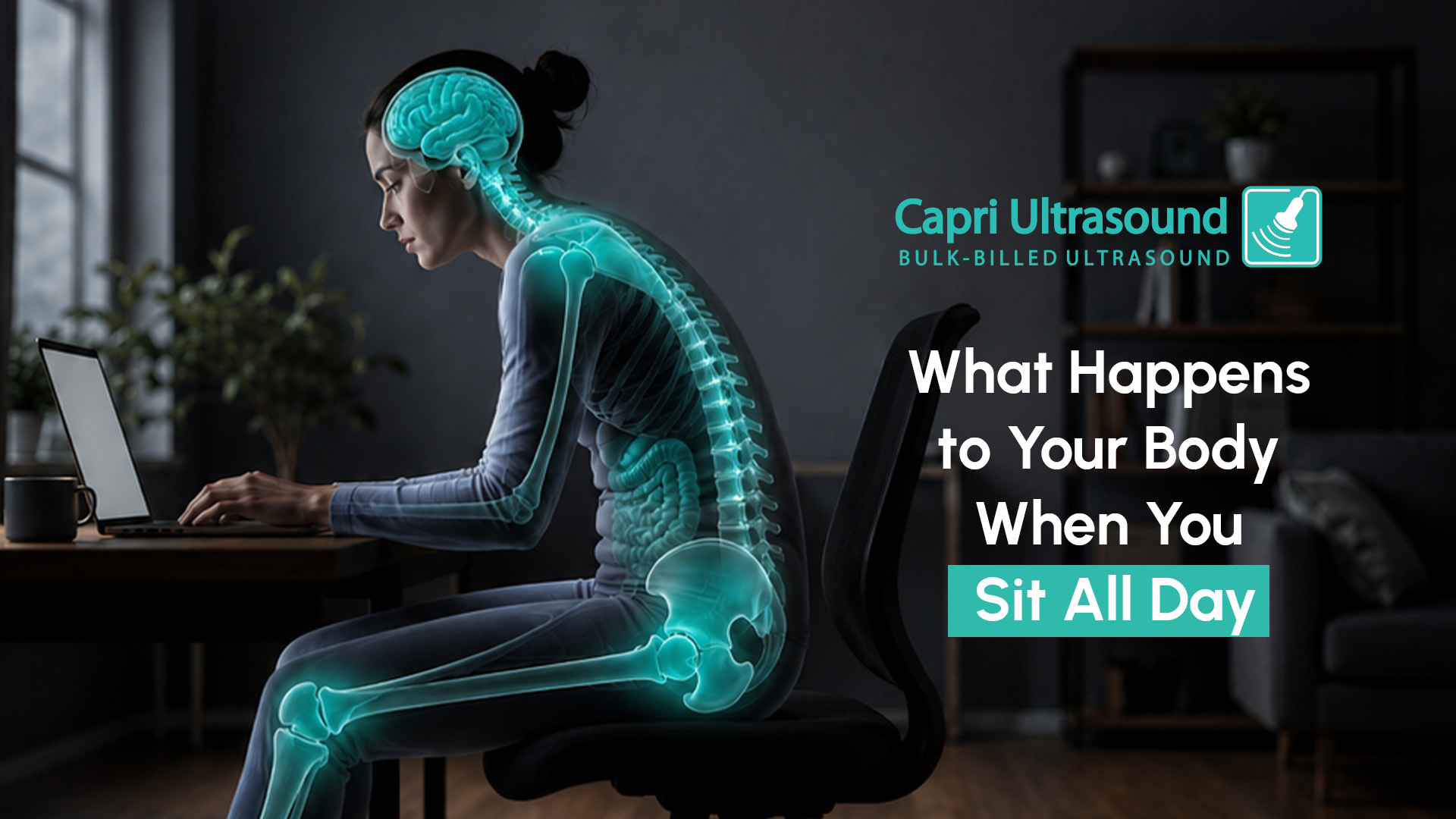
The average Australian adult spends between 8 and 10 hours a day sitting. Between the morning commute, a full day at a desk, and an evening on the couch, most of us are sedentary for the majority of our waking hours even if we exercise regularly. And while the discomfort of a stiff back or tired legs might feel like minor annoyances, the physiological effects of prolonged sitting run deeper than most people realise.
What’s particularly concerning is that many of the changes happening inside your body as a result of a sedentary lifestyle are completely invisible, no pain, no obvious symptoms, just gradual deterioration unfolding beneath the surface. This is where diagnostic ultrasound can play a surprisingly important role.
When you sit for extended periods, the muscles in your legs are largely inactive. Those muscles play a critical role in pumping blood back up from your lower limbs toward your heart it’s sometimes called the ‘muscle pump.’ Without that action, blood can pool in the veins of your legs, increasing pressure within the vessel walls and contributing to the development of venous insufficiency over time.
Prolonged sitting is one of the most well-established risk factors for developing varicose veins and chronic venous disease. It also significantly increases the risk of deep vein thrombosis (DVT) a blood clot forming in the deep veins of the calf or thigh. DVT can be life-threatening if a clot breaks off and travels to the lungs, which is why it’s taken seriously as a clinical concern.
Poor circulation from sedentary behaviour doesn’t only affect the venous side. Peripheral arterial disease a narrowing of the arteries that supply blood to the legs is more common in people who are inactive. The arteries rely on regular movement and healthy blood flow to stay supple and clear. A lifestyle that involves very little walking or lower-limb activity can contribute to early arterial changes that, if undetected, progress silently over years.
Sitting in a slouched or compressed posture puts continuous pressure on the abdominal cavity. Over time, this can contribute to issues with the gallbladder (particularly gallstone formation, which is associated with sedentary behaviour), fatty changes in the liver, and reduced kidney function in people who also have other risk factors like hypertension or diabetes.
The joints and soft tissues of the body are designed for movement. Extended sitting leads to tightness and degeneration in the hip flexors, compression in the lumbar spine, and progressive weakening of the muscles that stabilise the core and lower back. People who sit all day are significantly more likely to develop chronic hip, lower back, and knee pain and the tendons and bursae in these areas are often the first structures to show signs of strain.
The insidious thing about sedentary-related health changes is that they often develop without warning. Venous insufficiency can exist for years before visible varicose veins appear. Early peripheral arterial disease rarely causes symptoms until the narrowing is quite advanced. Gallstones can be completely asymptomatic until one becomes lodged.
This is one of the strongest arguments for proactive health investigation — especially for people over 40, those with desk-based jobs, or anyone with additional risk factors like smoking, hypertension, diabetes, or a family history of vascular disease.
Diagnostic ultrasound is uniquely well-suited to assessing the effects of a sedentary lifestyle because it visualises exactly the structures most affected blood vessels, soft tissue, and abdominal organs in real time, without radiation. Depending on your symptoms and risk profile, relevant scans might include:
None of these scans are invasive, none involve radiation, and all can be performed in a single visit or across a short series of appointments depending on what your GP recommends.
If you spend most of your day sitting whether at a desk, in a vehicle, or at home it’s worth having a conversation with your GP about whether any diagnostic imaging is appropriate for you. This is especially true if you’ve noticed leg heaviness, ankle swelling, occasional aching in the calves, or any unexplained abdominal discomfort. These can all be early signals that something is worth investigating.
The goal isn’t to create anxiety about sitting, it’s to give you the information you need to stay ahead of problems that are far easier to manage when caught early.
Capri Ultrasound on the Gold Coast is a bulk-billed diagnostic imaging clinic offering a full range of vascular, abdominal, and musculoskeletal ultrasounds. If you or your GP want a clearer picture of how your sedentary lifestyle may be affecting your body, their experienced sonographers can provide high-quality, detailed imaging with no out-of-pocket cost for eligible patients.
All that’s needed is a referral from your GP and the peace of mind that comes from knowing what’s actually going on inside is well worth the visit.